Safety & Risk Committee 2.0 – Part II

Victor Lawe
Regulatory Compliance/Safety Officer, City of Rocky Mount, NC

Click here for Part I.
Welcome back. I mentioned in Part I that we learned and accomplished a lot in one year. You saw the increase in safety programs. I left out the part about our key performance indicators (KPIs). They were as follows:
- 20% reduction in recordable injuries
- 20% reduction in vehicle incidents
- 100% increase in near-miss reporting
- 25% increase in safety training hours
You will notice a balance of two lagging indicators and two leading indicators. At the end of three years, if everything goes according to plan, the city will be three times better than it was three years ago across all KPIs. How did we do after one year?
See for yourself:

Full transparency is not a great news slide. We admittedly had a terrible year in recordables! Yet we exceeded expectations in all other categories. We took those lessons learned and turned them inward to affect change at the supervisory level. A decrease in citywide funding forced us to become more creative in our training. Instead of a paid outside training consultant, the friendly neighborhood safety officer divisions relied on supervisors and people with a desire to make a change in safety.
Year two, we are capitalizing on 2025’s success. We reviewed as a committee what went right.
We realized that top-down management involvement is the key to success.
We realized that many things were within their control; they just needed permission and training to execute them. The former culture was that “only a safety officer could perform a safety inspection. The OSHA training was an eye-opening experience that helped members understand safety and how it applies to their department. Over time, they saw their progress and saw the benefits of smaller-scale programs that fit their organization. Someone asked me, “If we develop our own safety programs and our own safety committees and our incident rate is zero, what do we need you for?”
I responded bluntly, “You don’t!”
“What will you do?”
“Focus my efforts on the departments that are struggling to match your greatness!”
Epilogue: Our recordables have NEVER BEEN BETTER. So far, year-to-date:
- We have reduced recordable injuries by 60%
- We have reduced vehicle incidents by 50%
- Near-miss reporting is increasing in waves
- Safety training is increasing in waves as well
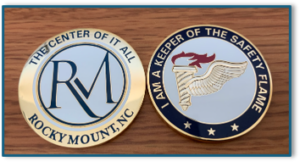
The committee is learning that ”KPIs that are measured get improved.” For the first time in recent city history, our Police Department received a Safety Award from the North Carolina Department of Labor. Near-miss reporting is a contagious thing. One division will report five in a month and go silent. Another division will do the same thing. We encourage these reports with safety challenge coins upon the completion of the preventive action.
In conclusion, this has been a wild and productive ride in moving the needle on safety. It exceeded my expectations in terms of the creativity and passion for safety that was there all along. All it needed was a little push and management support.
“Perfection is not attainable. But if we chase perfection, we can catch excellence.”
-Vince Lombardi
Victor Lawe
Regulatory Compliance/Safety Officer, City of Rocky Mount, NC
Summary of Qualifications
Victor is the Regulatory Compliance/Safety Officer for the City of Rocky Mount. He has a successful track record of progressive, continuously improving safety programs to best-in-class, and a talent for quickly implementing processes through hands-on training and problem solving.
Education
MBA, Indiana Wesleyan University
BA, Journalism, UDC